

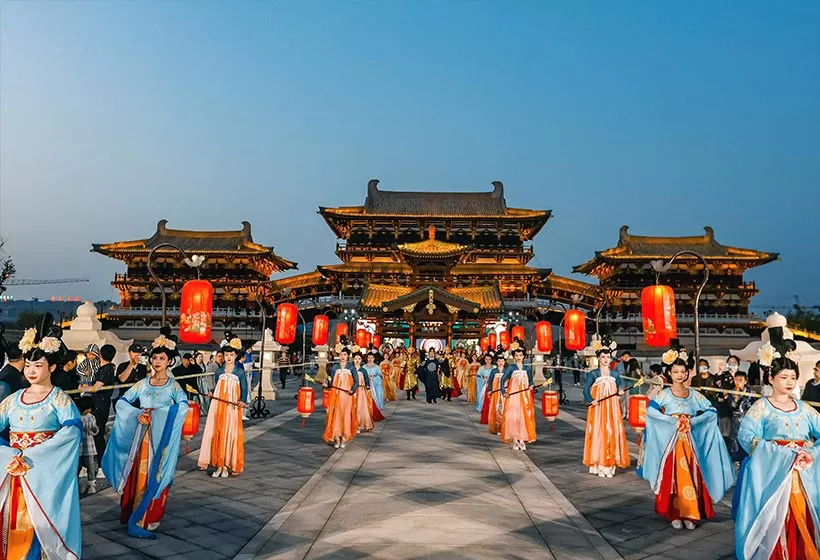
Short Introduction to Luoyang Local Culture: History, Nation, Diet, region culture etc
Luoyang, abbreviated as “Luo” and historically known as Zhongguo, Shendu, Luoyi, Chengzhou, and Luojing, is named for its location north of the Luo River in Henan Province. With over 5,000 years of civilization and more than 1,500 years as a political and cultural center, it is one of the first cities in China designated as a National Famous Historical and Cultural City. Known as the earliest capital in Chinese history, with the most dynasties and the longest duration as a capital city, Luoyang is also famed for its national flower, the peony, earning it the poetic titles “the Ancient Capital of a Thousand Years” and “the City of Peonies.”
Home to the magnificent Longmen Grottoes, the elegant White Horse Temple—the first Buddhist temple in China—and numerous imperial sites, Luoyang stands alongside Xi’an, Beijing , and Nanjing as one of China’s Four Great Ancient Capitals. With its rich cultural heritage, graceful landscapes, and deep historical resonance, Luoyang remains a living testament to the glory of China’s ancient past.
Brief History
Luoyang is not only an ancient capital of thirteen dynasties but also one of the cradles of Chinese civilization. From its origins during the Xia and Shang dynasties to its prosperity under the Zhou and Han, and its peak during the Sui and Tang periods, the city has witnessed countless dynastic changes and historical transformations. Serving as the political, economic, and cultural heart of the nation for centuries, Luoyang truly stands as a timeless symbol of China’s enduring heritage.
Xia Dynasty (c. 2070–1600 BC): Luoyang’s history dates back to the Xia Dynasty, when it was part of China’s earliest civilized regions along the Yellow River.
Shang Dynasty (c. 1600–1046 BC): Luoyang saw the establishment of one of the earliest capital systems. The origins of bronze ware and oracle bone inscriptions took shape here, laying the foundation for the development of Chinese civilization.
Zhou Dynasty (1046–256 BC): Luoyang, known as Chengzhou, served as the capital of the Eastern Zhou, witnessing the rise of Confucianism and the flourishing of ancient Chinese thought.
Northern Wei Dynasty (386–534 AD): Emperor Xiaowen relocated the capital to Luoyang, marking a flourishing period of cultural integration. The world-renowned Longmen Grottoes were first carved during this time, blending Buddhist art with Central Plains culture to create a distinctive and influential artistic style.
Han Dynasty (202 BC–220 AD): As the capital of the Eastern Han Dynasty, Luoyang became one of the world’s largest cities, a hub of politics, economy, and culture.
Wei, Jin, and Northern–Southern Dynasties (220–589 AD): Despite wars and instability, Luoyang remained a crucial cultural center and home to the magnificent Longmen Grottoes.
Sui and Tang Dynasties (581–907 AD): Luoyang reached its golden age, serving as the eastern capital of the Tang Dynasty and one of the most prosperous cities in the world. During the reign of Empress Wu Zetian, China’s only female emperor, the magnificent Mingtang (Hall of Enlightenment) was constructed, and large-scale expansion of the Longmen Grottoes took place. The Vairocana Buddha in Fengxian Temple stands as a brilliant masterpiece of Tang Dynasty sculpture.
Song, Yuan, Ming, and Qing Dynasties (960–1911 AD): Although it was no longer the capital, Luoyang continued to thrive as a regional political and cultural hub, preserving its ancient heritage.
In 1948, Luoyang was liberated and the Luoyang People's Democratic Government was established. Today, Luoyang is a city where history and modernity meet, known for its peony culture, Buddhist heritage, and rich archaeological legacy
Region Culture
Luoyang has a permanent population of 7.081 million, with 4.843 million living in urban areas. The local culture centers on Heluo culture, which integrates the essence of various historical periods, including the Han, Wei, Sui, and Tang dynasties. Heluo culture represents the core and source of China’s 5,000-year Huaxia civilization. As the eastern starting point of the Silk Road, Luoyang has witnessed extensive cultural exchange and integration between East and West. Its central position along the Grand Canal during the Sui and Tang dynasties further established Luoyang as a prosperous capital of numerous dynasties. The city also played a foundational role in Confucianism, served as the birthplace of Daoism, introduced Buddhism to China, and became a formative center for metaphysics and Neo-Confucianism.
Local Dialect
The Luoyang dialect, spoken in the Luoyang region of Henan Province, belongs to the Luosong subgroup of the Central Plains Mandarin dialects. Unlike Standard Mandarin, which has four tones, the Luoyang dialect features only three — level, rising, and departing — giving it a distinctive rhythm and sound unique to the region.
Architecture
Most of Luoyang’s surviving historical buildings retain traditional Chinese architectural styles. For example, the former residence of Li Zhanbiao on Dongdajie Street in the old city features green glazed tiles, gray brick walls, and other classical elements that reflect the heritage of one of Luoyang’s three great traditional Chinese medicine masters.
Buildings from the Republic of China era preserve the typical brick-and-wood structure, while the Qiyun Pagoda at White Horse Temple is a brick pagoda from the Jin Dynasty, harmoniously blending with the surrounding ancient trees.
Landmarks such as the 17.14-meter-tall Vairocana Buddha at the Longmen Grottoes, the Qiyun Pagoda at Guanlin (a Jin Dynasty brick structure), and the gilded Taoist temples atop Laojun Mountain enveloped in mist all stand as enduring cultural symbols of Luoyang — a city often revered as a “root of Chinese civilization.”
Ethnic Area
Chanhe District in Luoyang is not only one of China’s five urban districts with significant ethnic minority populations but is also known as the “East Gate of Luoyang.” The district is home to 22 ethnic groups, including the Hui, Manchu, and Mongolian peoples, creating a vibrant tapestry of multicultural life and unique local customs.Folk Festival
Luoyang Peony Festival (April–May):The Luoyang Peony Festival is the city’s most iconic cultural event, held annually from April to May with the exact dates adjusted according to the blooming season of the peonies. With the theme “Blossoms in Luoyang, Youth in Full Bloom,” the festival features a wide range of activities, including flower appreciation, cultural exhibitions, and trade fairs, offering visitors a vibrant experience of Luoyang’s charm and vitality.
Guanlin International Pilgrimage Ceremony (Held Annually on Guan Yu’s Birthday): Guanlin in Luoyang is believed to be the burial site of the head of Guan Yu, the renowned general of the Shu Kingdom during the Three Kingdoms period. It is regarded as the foremost among China’s three major temples dedicated to Guan Yu. For generations, the Chinese people have admired Guan Yu for his spirit of loyalty, righteousness, benevolence, and courage, while overseas Chinese venerate him as the God of Protection and the Martial God of Wealth. Guanlin Temple has long been a place of continuous incense offerings and pilgrimages. Since 1999, the International Pilgrimage Ceremony has been held here every October, is an annual event held in Luoyang to honor Guan Yu, the legendary general of the Three Kingdoms, attracting participants from around the world to pay tribute and celebrate his legacy.
Laba Festival (the Eighth Day of the Twelfth Lunar Month): The Laba Festival is an important traditional folk festival in Luoyang, celebrated annually on the eighth day of the twelfth lunar month. Its origins trace back to ancient rituals of ancestor worship and sacrifice to various deities. By the Han Dynasty, it had evolved into a time for family gatherings and ancestral offerings, and during the Northern and Southern Dynasties, the date was fixed on the eighth day of the twelfth lunar month. To this day, people in Luoyang maintain the custom of drinking Laba porridge, a rich blend of grains, beans, and dried fruits that symbolizes abundance and good fortune.
Danao Ceremony: Although not an independent festival, the Danao Ceremony is an important folk ritual held on the day before Laba Festival (traditionally the third xu day after the Winter Solstice, later fixed on the eighth day of the twelfth lunar month). With deep historical roots, it originated in the Zhou Dynasty as a ritual to drive away evil spirits and disease. By the Han Dynasty, it had evolved into a state-level ceremonial practice. As an ancient capital, Luoyang was once a central location for this ceremony. During the ritual, participants wear masks and carry ceremonial instruments, performing dances and chanting scriptures to pray for peace and safety.
Diet Style
Luoyang’s geographical location and climate have fostered a strong local preference for soups, helping residents combat dryness, cold, and dampness. This has given rise to a unique “soup culture.” In this ancient city, known as the “City of Soup,” drinking soup is more than a culinary habit—it is a lifestyle and a way to experience the city’s distinctive charm. Passed down through generations, Luoyang locals follow specific rules for soup consumption, observing the principle of “sweet in the morning, savory at night; meat in the morning, vegetables at night.”
Luoyang cuisine is generally bold in flavor, leaning toward salty and spicy tastes. The city offers a wide variety of soups, with the Luoyang Water Banquet—a national intangible cultural heritage—being its most famous culinary treasure. Together with the Peony Festival and Longmen Grottoes, it forms the “Three Wonders of Luoyang.” Beyond the Water Banquet, other iconic local soups include beef soup, mutton soup, donkey soup, and Bufan Tang, each showcasing the richness of Luoyang’s soup culture.
Read More Food-Restaurants in Luoyang »
Cultural Heritage
Luoyang’s rich cultural heritage is embodied in its remarkable archaeological and intangible legacies. The city is home to five major ancient capital sites—the Erlitou Site, the Yanshi Shang City Site, the Eastern Zhou Royal City Site, the Han–Wei Luoyang City Site, and the Sui–Tang Luoyang City Site—each marking a significant chapter in Chinese civilization. Beyond its ancient capitals, Luoyang’s cultural vitality continues through its diverse folk traditions and craftsmanship. Intangible cultural heritages such as Luoyang paper-cutting, Tang Sancai pottery, peony porcelain making, and Pingle Peony Painting reflect the city’s artistic ingenuity and the enduring spirit of inheritance and innovation among its people.
Customize Your Authentic Luoyang Tour
If you are interested in the Luoyang itineraries mentioned above, please contact us, and we will be happy to customize it and provide a quote tailored to your preferences.
Alternatively, if you would like to customize your Luoyang Tour, please visit our Henan Tour Customized Center. We assure you that you will receive a reply within 24 working hours.
Informative Articles for Your Luoyang Trip
 Luoyang
- Travel Guide: attractions, weather, hotels, food, etc.
- Weather: best time and seasons to visit Luoyang
- Top attractions: well-selected top attractions in Luoyang
- Local culture: brief history, folk culture, festivals, etc.
- Top destinations: best places to visit in Luoyang
- Travel itineraries: itineraries for your reference
- Abundant activities: Luoyang cultural immersions
- Unique perspective: top interesting things to do
- Local food: what to eat while traveling in Luoyang
- Luxury hotels: accommodation to stay in Luoyang
- Luoyang Tours: customized tours for your reference

GREAT FAMILY CHINA TOUR
JULY 2024 We wanted to thank Grace at China Culture tour for organizing a great tour of China. We enjoyed our Beijing - Xian-Chengdu -Guilin -Yangshuo - Shanghai trip. Our local guides Bruce in Beijing, Susan in Xian, Jane in Chengdu, Mike in Guilin and Mary in Shanghai took care of us…read more details »
Teng Han L from SINGAPORE
Ready to Create a Unique Dream Travel?