


Top Yunnan attractions and best sightseeing
Yunnan’s landscapes are remarkably diverse, from snow-capped mountains and highland lakes to tropical rainforests, dramatic karst formations, and the sweeping Hani rice terraces. As the saying goes, “One mountain can have four seasons, and the weather can change every few miles.” The province is also home to six UNESCO World Heritage properties, reflecting its remarkable natural, ethnic, and cultural diversity. From the historic streets of Lijiang and the lakeside charm of Dali to the vibrant city of Kunming and the highland landscapes of Shangri-La , each destination offers a different side of Yunnan, making the province an exceptional place to explore.
This list just scratches the surface of the many attractions that Yunnan has to offer, but it's a great start for those looking to explore this diverse and fascinating province.
Top 1: Stone Forest / Kunming
 Stone Forest
The Stone Forest, known as Shilin in Chinese, is a UNESCO World Heritage Site spanning more than 350 square kilometers. It features a spectacular landscape of limestone formations that rise like a forest of stone pillars, jagged peaks, and striking natural shapes. These unique rock formations have been created over millions of years by the forces of nature, such as Deposition, Uplift, Erosion Magma, water erosion and tectonic activity.
The area is divided into several scenic zones; there are two famous sites: the Greater Stone Forest and the Lesser Stone Forest. The area is not only a geological paradise but also rich in cultural and ethnic heritage. Visitors can explore the labyrinthine paths among the stones, enjoy the beautiful natural scenery, and learn about the local traditions and folklore. It attracts tourists from all over the world who come to marvel at its.
Tips: The Shilin Scenic Area is quite large, and the ticket office is about a 10-minute drive from the main entrance. It is recommended to take the sightseeing shuttle bus to reach the entrance.
- Address: Shilin Yi Autonomous County, Kunming City, 85 km from Kunming Downtown
- Open Hours: 8:00-18:00
- Tour Length: 2-4 hours
Top 2: Dali Ancient City / Dali
 Dali Ancient Town
The history of Dali Ancient City can be traced back to the Tang Dynasty during the Tianbao era. Step through the ancient South Gate and discover a historic world that has endured for centuries. This ancient city, nestled between Erhai Lake to the east and Cangshan Mountain to the west, was established in the 15th year of the Hongwu period of the Ming Dynasty. Dali Ancient Town, once the capital of the Nanzhao Kingdom, is one of China's first historical and cultural cities.
Apart from Fuxing Road, which is more commercialized, the rest of the area remains quite local, as many local residents still live in the nearby small streets. The most striking features within the ancient city are the Bai-style architecture, with its exquisite carvings and courtyard layouts, complemented by the bluestone pavements, and city wall creating a vivid tapestry of Dali Ancient City. Wuhua Tower, the highest point in the ancient city, offers a panoramic view of the stunning scenery of Dali from its summit. There is a unique Guandi Temple in the ancient city, established in 1386, boasting a history of over 600 years.
Here, you will find not only ancient relics but also the warm hospitality of the Bai people and authentic cuisine waiting for your arrival. In every corner of Dali Ancient City, which is one of Yunan’s most popular tourist destinations, you can feel the charm of this historic attraction.
- Open Hours: 08:00-18:00
- Tour Length: 2 hours
- Address: Dali Ancient Town, Dali
Top 3: Erhai Lake / Dali
 Erhai Lake
 is one of China's famous freshwater lakes and the second-largest lake in Yunnan, known as the "Pearl of the Plateau," Erhai was formed during the last ice age and sits at an elevation of 1,972 meters. It stretches 40 kilometers from north to south and varies in width from 3 to 9 kilometers. The lake is named Erhai, meaning "Ear Sea," due to its ear-like shape.
Each season showcases its beauty, with the crystal-clear blue waters reflecting white clouds and the distant Cangshan Mountain. Erhai Lake is quite long, so touring the lake can be divided into the western and eastern sections. In the western, you can leisurely bike along the lake's corridors, take a family-friendly boat ride, and visit the ancient town of Xizhou, which features numerous Bai ethnic architectural styles. The eastern side including the Xingsheng Bridge, Lixiangbang, Wenbi Village, a charming little island in Erhai Lake called xiaoPutuo Island, and the ancient town of Shuanglang. Flocks of seagulls add vibrancy in winter (the migration period for migratory birds to spend the winter primarily occurs from late October to March or April of the following year), and the gentle breeze makes it an inviting place to stay.
- Distance and drive-time : 2 km, 5 mins
- Open Hours: All day
- Tour Length: 1-3 day
- Address: Dali Ancient Town, Dali
Top 4: Shaxi Ancient Town / Dali
 Shaxi Ancient Town
Shaxi Town is a key point on the Ancient Tea Horse Road and situated between the major tourist areas of Dali, Lijiang, and Shangri-La. It takes about two hours by car from either Dali or Lijiang to reach Shaxi.
If you are looking for an authentic ancient town of Dali, I highly recommend visiting Shaxi Ancient Town. it is less commercialized than Dali Ancient Town, its historical sites are well-preserved, and it is the only still-functioning marketplace of the Ancient Tea Horse Road in the country. You will understand why I recommend it after visiting this place.
It is like a gem hidden in Dali, the town is predominantly inhabited by the Bai ethnic group, along with Han, Yi, and Lisu people. Shaxi Town is small, but it boasts famous attractions, including the 'Ancient Opera Stage,' 'Yujin Bridge,' 'Dongzhai Gate,' 'Sideng Street,' and 'Xingjiao Temple. In 2001, the world Monument Fund nominated the Shaxi Market Place on the list of 101 Most Endangered Sites.
Siden Street is not only an important trading hub on the Yunnan-Tibet Tea Horse Road but also the only still-functioning marketplace of the Tea Horse Road. Every Friday, Bai people from the surrounding areas gather on this ancient street to trade their goods, including tea, wild mushrooms, medicinal herbs, and more, creating a lively and bustling atmosphere.
- Distance and drive-time : 130 km, 2 hours
- Open Hours: All day
- Tour Length: a day
- Address: Dali Ancient Town, Dali, Yunnan Province
Top 5: Lijiang Ancient Town /Lijiang
 Lijiang Ancient Town
Lijiang Old Town, also known as Dayan Ancient Town, is a national-level historical and cultural city and a UNESCO World Heritage Site. First established in the late Song Dynasty and early Yuan Dynasty in the late 13th century, it is one of the best-preserved ancient towns in China and is known for its distinctive Naxi cultural heritage.
At the heart of the old town is Sifang Street, a historic square that has long served as a lively center for trade and daily life. From here, a network of stone-paved streets, small bridges, and waterways leads through traditional Naxi houses, shops, courtyards, and narrow lanes. The old town is famous for its harmonious layout, with clear streams flowing through the streets and waterwheels and stone bridges adding to its distinctive charm. In the evening, the streets become lively with restaurants, bars, and traditional music, offering a different atmosphere from the peaceful daytime scenery.
- Address:Gucheng District, Lijiang, Yunnan
- Open Hours: All day
- Tour Length: 0.5-1day
Top 6: Jade Gragon Snow Mountain /Lijiang
 Jade Gragon Snow Mountain
In the Naxi language, Jade Dragon Snow Mountain is called "Olu," meaning "Heavenly Mountain." Its thirteen snow-capped peaks stretch continuously, resembling a "giant dragon" soaring and dancing, which is why it is named "Jade Dragon." It is considered a sacred mountain in the hearts of the Naxi people. It remains covered in snow year-round, with the snow line ranging between 4,800 and 5,000 meters.
Nearby notable spots within the area are Blue Moon Valley, is famous for its breathtakingly beautiful, turquoise-blue lakes, which are fed by melted snow from the nearby peak. Yak Meadow, known for its vast grasslands and panoramic views of the mountain, Sometimes, you can even see yaks leisurely grazing on the grassland. Spruce Meadow, a serene forested area surrounded by lush greenery, perfect for nature walks and capturing the beauty of the mountain.
Tips: Remember to keep warm and bring oxygen tanks. During peak seasons and holidays, you may have to wait for cable car in long queues.
- Address: Yulong Naxi Autonomous County, Lijiang, Yunnan Province
- Open Hours: 06:30 AM – 05:00 PM
- Tour Length: 1day
Top 7: Tiger Leaping Gorge / Lijiang
 Tiger Leaping Gorge
 is one of the deepest gorges in China and it is also one of the most famous gorges in the world for its precipitous terrain. A place that one must hike at least once in your lifetime. It is renowned for its dramatic and rugged scenery. The gorge is situated on the upper reaches of the Jinsha River, with a total length of 17 kilometers and a winding road of 25 kilometers. After the river flows into the gorge, it narrows to just over 50 meters at its narrowest point, where a tiger or leopard could leap across, hence the name Tiger Leaping Gorge.
- Address: Approximately 86 kilometers (53 miles) north of Lijiang City and about 106 kilometers (66 miles) from Shangri-La
- Open Hours: 09:00 AM – 06:00 PM
- Tour Length: 2–3 hours for a short visit; 1–3days for hiking
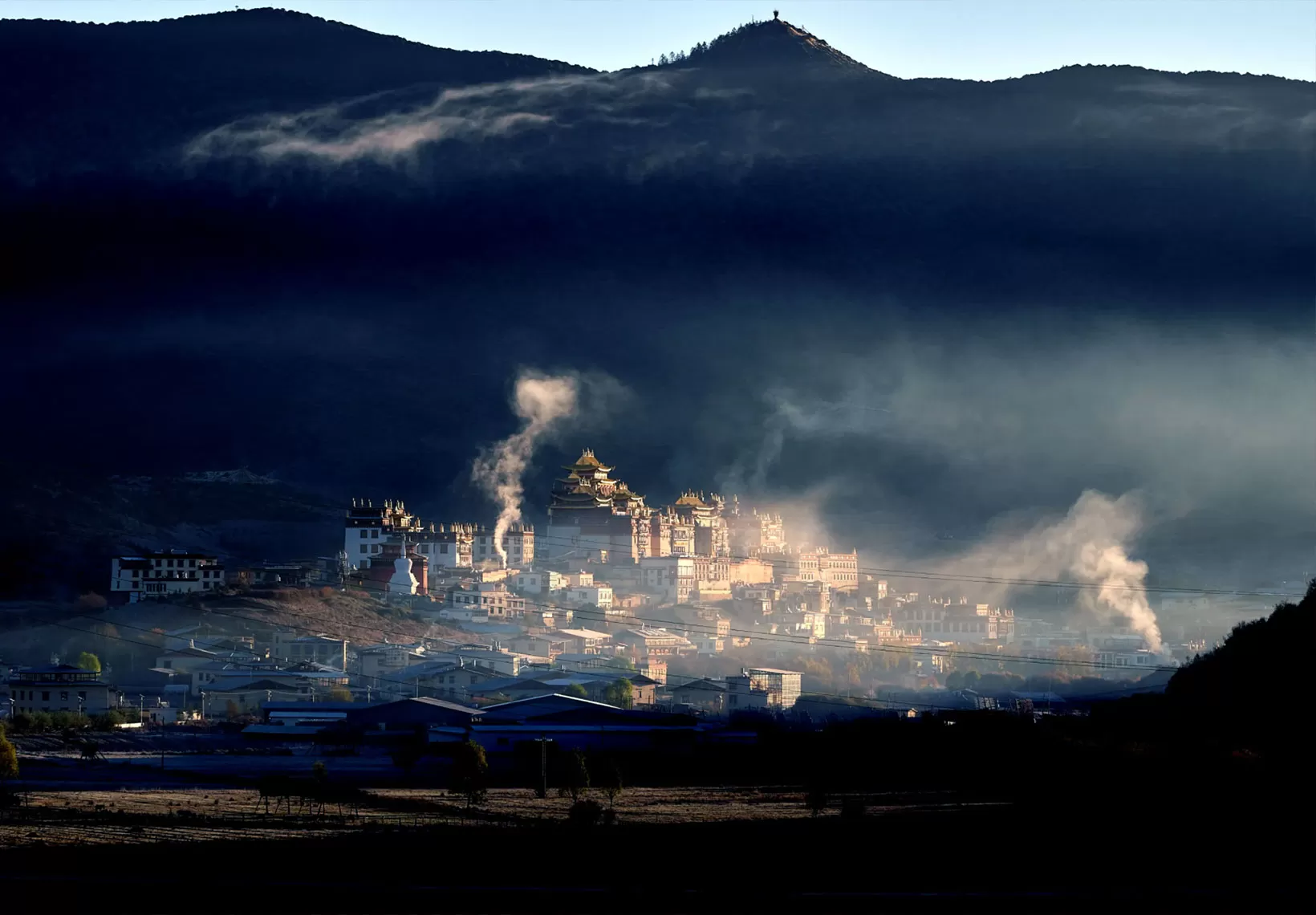
Top 8: Ganden Sumtseling Monastery (Songzanlin Monastery)/ Shangri-la
 Songzanglin
The largest Tibetan Buddhist monastery in Yunnan, A beautiful Tibetan monastery with colorful prayer flags and beautiful architecture. also known as the 'Little Potala Palace'.
Songzanlin Monastery, also known as Ganden Sumtseling Monastery. The monastery is situated on a hillside in the town of Zhongdian (now renamed as Shangri-La), which is located in the northwest of Yunnan.
The monastery was founded in the 17th century by the Fifth Dalai Lama and is home to more than 700 monks. The complex includes several prayer halls, courtyards, and living quarters for the monks, and is known for its intricate architecture and stunning views of the surrounding mountains.
The main prayer hall, known as Zhacang, is the largest building in the monastery and is decorated with intricate frescoes and statues of Buddha and other Buddhist deities. Visitors can also explore the smaller prayer halls, which house numerous precious artifacts, including ancient texts, thangkas (Buddhist paintings on cloth), and sculptures.
Today, Songzanlin Monastery remains an important center for Tibetan Buddhism in China and attracts both pilgrims and tourists from around the world. Every year during the Gedong Festival, grand sacrificial ceremonies are held at Songzanlin.
Things to See: The Songzanlin Monastery is a sprawling complex with many temples, courtyards, and prayer halls. Some of the must-see sights include the main hall, the Golden Temple, and the Hall of the Wheel of Life. You can also take a guided tour to learn more about the history and significance of the monastery.
Tips: As a religious site, visitors should dress modestly and avoid shorts, sleeveless tops, or revealing clothing. Wear comfortable shoes, as the monastery has many stairs and steep paths. Be respectful of local customs by avoiding loud behavior and not taking photos or videos inside temple halls. A small donation or offering is also appreciated.
Top 9: Dukezong Ancient Town / Shangri-la
The Tibetan name "Dukezong" has two meanings: one is "castle built on stone," and the other is "moonlight city."
Dukezong is located in Shangri-La, the Diqing Tibetan Autonomous Prefecture of Yunnan Province. It is an ancient city built on Guishan Mountain and was a key point on the Tea Horse Ancient Road. With a history of over 1,300 years, it is the largest and best-preserved ancient architecture in the area, strongly influenced by Tibetan culture. Between 676 and 679 during the Tang Dynasty the Tubo people established Shengchuang on Guishan Mountain, later founding Dukezong City, which became known as the 'Iron Bridge East City.' In the Qing Dynasty, Dukezong became an important market for trade between Yunnan and Tibet.
One of the highlights is Guishan Park, where the Great Buddha Temple and the famous Giant Prayer Wheel stand above the old town. The 21-meter-tall prayer wheel is said to be the largest of its kind in the world and takes several people to turn. From the top of Guishan Mountain, you can also enjoy panoramic views of Dukezong Ancient Town and the surrounding highland landscape.
- Address: in Shangri-La County, Diqing Tibetan Autonomous Prefecture, Yunnan Province.
- Open Hours: 08:00 Am—6:30 Pm
- Tour Length: 2-3 hours
Top 10: Meili Snow Mountain / Shangri-la
 Meili Snow Mountain
One of the most beautiful mountains in China, also known as the 'Prince of Snow Mountains'. There are 13 mountain peaks, the main peak, Kawagebo, reaches an elevation of 6,740 meters and is the highest peak in Yunnan. The Meili Snow Mountains are one of the four sacred mountains in Tibetan Buddhism "The best time to view Meili Snow Mountain is from April to October."
Meili is located at the confluence of the Three Parallel Rivers, within the Jinsha River Great Bend Scenic Area, which is listed as a UNESCO World Natural Heritage site. The scenic area includes Mingyong Glacier, waterfalls, the Feilai Temple viewing platform, Moon Bay, Yubeng Scenic Area, and Wusongding.
Tips: Remember to keep warm and bring oxygen tanks. Meili Snow Mountain does not have a cable car; it can only be accessed by hiking.
- Address: in Deqin County, Diqing Tibetan Autonomous Prefecture, Yunnan Province.
- Open Hours: 08:00 Am—4:30 Pm
- Tour Length: 1-2 day
Top 11: Dongchuan Red Land / Kunming
 Dongchuan Red Land
, located northeast of Kunming, is renowned for its strikingly colorful landscape. The soil here is rich in iron and aluminum, which creates a dazzling palette of hues. Over generations, local farmers have carefully cultivated this land, shaping a one-of-a-kind spectacle often compared to the red soil of Rio de Janeiro in Brazil. It is regarded as the most magnificent red land in China.
From above, the rolling mountains and open fields unfold in layers of deep red, purplish red, and brick red, interwoven with vibrant seasonal colors — golden wheat in spring, blooming rapeseed flowers in autumn, and patches of snow in winter. This ever-changing scenery makes it a paradise for photographers. The main sightseeing routes include the Northwest Line, Northeast Line, and South Line, with highlights such as Damakan, Jinxiu Garden, Luoxiagou, and Lepu’ao. Viewed from above, these spots reveal breathtaking natural compositions, like a giant canvas painted by nature itself.
Beyond its natural wonders, Dongchuan Red Land is also a cultural treasure. It is home to several ethnic minorities, including the Yi and Miao people, whose traditional attire, customs, and heritage are well preserved and vividly displayed here.
Tips: The best time to visit the Red Land is from April to May when the wheat ripens, from September to December when the rapeseed flowers are in full bloom, and in February to March when remnants of snow may still cover the fields.
- Address: Huashitou Tourist Resort, Dongchuan District, Kunming City, Yunnan Province
- Open Hours: All day
- Tour Length: 3 hours
Top 12: Yuanyang Rice Terraces / Honghe
 Yuanyan Rice Terraces
Yuanyang Rice Terraces are the result of the wisdom and hard work of the Hani people, who carved this magnificent landscape out of the mountains ranging from 144 to 2,939 meters in elevation, over the course of 1,300 years. Recognized by UNESCO as a World Cultural Heritage site, the terraces embody a unique harmony between humans and nature.
At the mountaintops, forests serve as the water source; intricate canals, like capillaries, channel the water down into the terraces; and Hani villages are nestled among the fields, positioned both for farming convenience and to safeguard the land that sustains them. Layer upon layer, the terraces cascade down the mountainsides like the rings of the earth, recording centuries of cultural wisdom. The scenery changes dramatically with the time of day and season. At sunrise and sunset, when golden light falls upon the flooded paddies, morning mist and colorful clouds reflect on the water’s surface, creating the famed “pink terraces” spectacle. The most celebrated viewing spots include Duoyishu Terraces, Laohuzui (Tiger Mouth) Terraces, and Bada Terraces, each offering breathtaking perspectives of this cultural landscape.
- Address: Southern Ailao Mountain, Yuanyang County, Honghe Hani and Yi Autonomous Prefecture, Yunnan Province
- Open Hours: 06:00—19:30
- Tour Length: 2-3 hours
Top 13: Wild Elephant Valley (Gajah Liar Valley) / Xishuangbanna
 Wild Elephant Valley
 is a large nature reserve located 32 kilometers from Jinghong. There are approximately 300 wild Asian elephants distributed throughout China, with more than 250 of them found within the Xishuangbanna region.
Opened to the public in 1996, the Wild Elephant Valley Scenic Area not only serves as a habitat for various wildlife, including Asian elephants, monkeys, black bears, golden leopards, water deer, peacocks, butterflies, and various bird species, but it also offers views of the diverse ecological landscapes of tropical rainforests. Along the pathways for visitors, there are over 400 species of higher plants.
Visitors can learn about the natural behaviors of wild elephants on the ground through the sightseeing cable car and the elevated observation deck. This is the only place in China where Asian elephants can be closely observed in a relatively safe manner.
The main attractions of the Wild Elephant Valley Scenic Area include the Elevated Observation Walkway, the Asian Elephant Museum, and the Butterfly Garden.
- Distance and drive-time :32km, 45mins
- Open Hours: 08:00-18:00
- Tour Length:2-4hours
- Address: National Road 213, Menglun Town, Mengla County, Xishuangbanna
Top Attractions for Photography
Jade Dragon Snow Mountain: Visit early in the morning to capture the golden glow of sunrise on the snow-capped peaks. The turquoise waters of Blue Moon Valley create beautiful compositions with the mountains, and on clear days, you may even capture their reflections in the water.
Meili Snow Mountain: One of the best places to photograph the spectacular “sunshine on the golden mountain” phenomenon. The best viewing season is generally from October to May, with late October to February offering a higher chance of clear views.
Songzanlin Monastery: Arrive early in the morning to photograph the monastery surrounded by mist and mountain scenery. The combination of Tibetan architecture, prayer flags, and soft morning light creates an atmospheric scene.
Yuanyang Rice Terraces: From December to March, the flooded terraces resemble countless mirrors reflecting the sky and surrounding mountains. Duoyishu is one of the best places to capture the terraces at sunrise.
Dongchuan Red Land: Rich in iron and aluminum, the soil takes on striking shades of red. Fields of different colors create dramatic patterns across the landscape, earning the area its nickname as an “artist’s palette.”
Erhai Lake: Longkan Pier and the S-shaped bend are popular photography spots, especially at sunrise and sunset when the changing light creates beautiful reflections and silhouettes across the lake.
Customize Your Unique Yunnan Tour

If you are interested in one of the Yunnan itineraries mentioned above, please contact us, and we will be happy to customize it and provide a quote tailored to your preferences.
Alternatively, if you would like to customize your Yunnan Tour, please visit our Yunnan Tour Customized Center. We assure you that you will receive a reply within 24 working hours.
Informative Articles for Your Yunnan Trip
 Pudacuo National Forest Park, Shangri La
- Travel Guide: attractions, seasons, hotels, food, itineraries, etc.
- Top attractions: well-selected top attractions in Yunnan
- Top destinations: places to visit in Yunnan
- Travel itineraries: best itineraries for your reference
- Weather: the best time and seasons to visit Yunnan
- Cultural immersions: Yunan cultural immersions
- Abundant activities:hands-on activities to spotlight your trip
- Unique perspective: top different things to do
- Local food: what to eat while traveling in Yunnan
- Luxury hotels: where to stay in Yunnan
- Yunnan Tours: tailor-made Yunnan Tours for your reference


GREAT FAMILY CHINA TOUR
JULY 2024 We wanted to thank Grace at China Culture tour for organizing a great tour of China. We enjoyed our Beijing - Xian-Chengdu -Guilin -Yangshuo - Shanghai trip. Our local guides Bruce in Beijing, Susan in Xian, Jane in Chengdu, Mike in Guilin and Mary in Shanghai took care of us…read more details »
Teng Han L from SINGAPORE
Ready to Create a Unique Dream Travel?